Experiencing Blue Cheese
June 01 2020
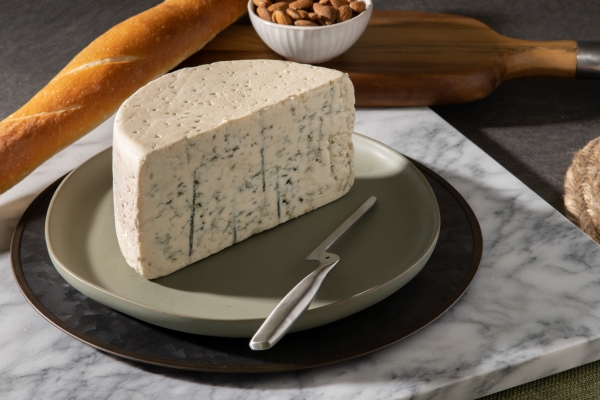
Picture this—you’ve just taken that first delectable bite of Blue cheese. You close your eyes to fully experience the intimate flavors that take over your taste buds. Your eyes reopen to savor bite number two and, you notice it—the veins in your “Blue” cheese are actually green, or perhaps even yellow. Do your eyes deceive you? Is this how it’s supposed to look? Who named this thing “Blue” cheese anyway?
We often hear this question from cheese lovers across the country. If you’re like most, you may not have the Code of Federal Regulations in your reading list, but fear not—we do! If we take a peek at Title 21, Chapter 1, Subchapter B, Part 133.106, (which we happen to have bookmarked in our Favorites), it reads:
“Blue Cheese:
- Description. (1) Blue cheese is the food prepared by the procedure outlined in paragraph (a)(2), of this section, or by any other procedure which produces a finished cheese having the same physical and chemical properties. It is characterized by the presence of bluish-green mold, Penicillium roquefortii, throughout the cheese. The minimum milkfat content is 50 percent by weight of the solids and the maximum moisture content is 46 percent by weight, as determined by the methods described in 133.5. The dairy ingredients used may be pasteurized. Blue cheese is at least 60 days old.”
This definition gives us cheesemakers considerable latitude in creating a wide variety of unique blue cheeses, and that’s just what we love doing! If you want to get real technical (and let’s be honest, we like to!) the Penicillium roquefortii oxidizes fatty acids and produces methyl ketones, giving Blue cheese its characteristic flavor. There are, in fact, many strains of this beloved fungus that can be used to craft a Blue cheese. The strains chosen greatly influence the flavor and texture of the finished cheese, but also, the color of the veining! Veining can range from yellow-green to dark blue.
But wait, there’s more! During the aging process, the mold, deprived of oxygen, essentially “goes to sleep”, and this hibernating mold can slowly lose its color, fading from blue to green, and green to yellow. Months later, when a cheese lover like yourself takes that first savory bite, you are giving the cheese a wake-up call (what a way to be woken up, eh?) If you allow the cheese to breathe at room temperature for about 30 minutes, you can see the blue/green color magically restore as the Penicillium roquefortii awakens! But the real question is, with Blue cheese this good, who can honestly wait a whole 30 minutes before taking another bite?!